
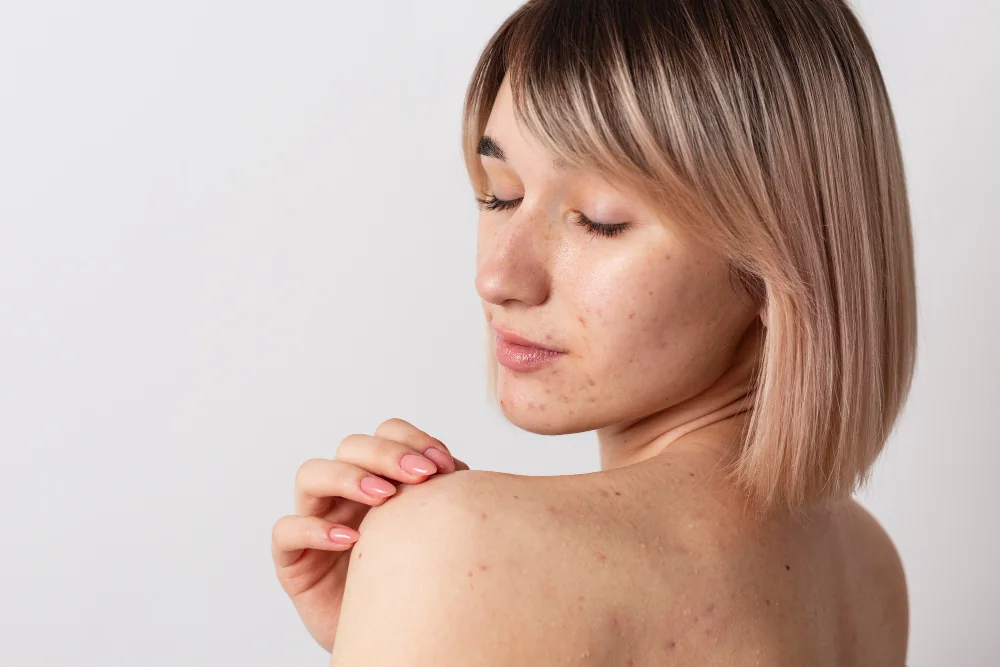
Are your spots failing to improve with the usual anti-acne products? Have small, uniform-looking spots appeared on your forehead, chest or back, and do they itch as well? It is possible that this is not common acne, and that the problem is fungal acne.
The essentials in brief
- "Fungal acne" is not acne: it is in fact Malassezia folliculitis, that is, an inflammation of the hair follicles.
- Typically, many small lesions of similar size, often itchy, appear at the same time.
- Typical locations: forehead, hairline, chest, shoulders and back.
- The treatment differs from that of common acne, so the correct diagnosis matters: the suspicion can be confirmed by a microscopic examination.
- If your "acne" does not improve with the usual treatment, it is worth consulting a dermatologist.
Because the two conditions look similar, fungal acne is easily misdiagnosed, which can delay the appropriate treatment. Its development can be favoured by a warm, humid environment, increased sebum production and blockage of the hair follicles, among other factors. Treatment is usually based on antifungal medicines applied topically or – in justified cases, based on medical judgement – taken by mouth. Some anti-acne active ingredients, such as benzoyl peroxide or retinoids, may also be useful, but using them does not replace an accurate diagnosis and the treatment that follows from it.
If you would like to learn more about how acne develops in general, its types and its treatment, read our comprehensive guide to acne.
What is fungal acne?
Fungal acne, whose medical name is Malassezia folliculitis (MF), is a dermatological condition that affects the hair follicles. A yeast called Malassezia plays a role in its development; it is naturally present on almost everyone's skin, but under certain circumstances it can overgrow and cause inflammation.
Fungal acne typically appears as small, very similar-looking, red and often itchy spot-like lesions. This is exactly why it is easy to confuse it with other skin problems, especially with common acne (acne vulgaris). This does not only make recognition harder: a mistaken diagnosis can also delay the appropriate treatment.
In a study of 320 people, this was the proportion of Malassezia folliculitis among those who had been diagnosed with acne in the consulting room.
In the same study, people with Malassezia folliculitis reported itching this much more often than patients with common acne.
In a multicentre study covering 353 cases, this was the proportion of patients whose main complaint was itching.
The figures suggest that fungal acne is not rare and that it is often treated as common acne – and that itching is one of the most important distinguishing signs. The exact proportion may differ depending on the study and the geographical region.
Is fungal acne really caused by a fungus?
Yes, but it is not the case that the skin "catches" a foreign fungal infection. Malassezia yeasts are part of the skin's natural microbiome and usually cause no problems at all.
Certain circumstances, however, can favour their overgrowth. These include, for example, a warm, humid environment, heavy sweating or blockage of the hair follicles. If Malassezia overgrows in the hair follicles, inflammation can develop and the characteristic spot-like lesions can appear.
What is Malassezia folliculitis?
Malassezia folliculitis is an inflammation of the hair follicles linked to the Malassezia yeast. The word "folliculitis" means inflammation of the hair follicles – so even the medical name shows why the everyday term "fungal acne" is not entirely accurate.
Although it may indeed look like acne, it is not the same condition as acne vulgaris. What is more, the two can even be present at the same time, which can make recognition even harder. This matters because the treatment of the two conditions is not entirely the same either.
Is fungal acne contagious?
No, fungal acne is not considered a contagious skin disease in the classical sense. This is because Malassezia, which plays a role in its development, is normally present on human skin as well.
So there is no need to worry about "catching" fungal acne from someone through simple contact. What matters far more is whether conditions develop on the skin that favour the overgrowth of Malassezia and the inflammation of the hair follicles.
How can you recognise fungal acne?
Fungal acne usually appears as many small, very similar-looking spots. The lesions often itch and appear mainly on the more sebum-rich areas of skin, such as the back, the chest and the shoulders. They can, however, also occur on the neck, the arms and the face.
Unlike common acne, fungal acne is not typically accompanied by blackheads, and the lesions are usually much more uniform. These signs can help raise the suspicion of fungal acne, but on their own they are not enough for a definite diagnosis.
What does fungal acne look like?
Fungal acne is characterised by small, round, red or skin-coloured spot-like lesions, some of which may look like pus-filled blisters. Typically, many of them appear at the same time, and their size and appearance are very similar.
This can be an important difference compared with common acne, where blackheads, smaller spots and larger, inflamed nodules are often found at the same time.
Does fungal acne itch?
Yes, itching is one of the common symptoms of fungal acne. According to the literature, more than half of those affected experience itching: in a study covering 353 cases, this was the main complaint of 83.9% of patients.
So if many small, uniform and itchy spots appear – especially on the chest, back or shoulders – this may raise the possibility of Malassezia folliculitis. Itching alone, however, does not prove that this is fungal acne.
Are there blackheads in fungal acne?
Blackheads are not typical of fungal acne. This is one of the important signs that can help distinguish it from common acne.
In acne vulgaris, open and closed blackheads are common, and spots of different sizes can appear at the same time. In fungal acne, by contrast, there tend to be many lesions of similar size that often itch.
It is important to note, however, that the two problems can even be present at the same time, especially in adolescents. For this reason, it is not always possible to decide with certainty from the appearance of the spots alone whether this is fungal acne or common acne.
Fungal acne or common acne – what is the difference?
Fungal acne (Malassezia folliculitis) and common acne (acne vulgaris) are easy to confuse, since both can cause spot-like, inflamed lesions. An important difference, however, is that while the overgrowth of a yeast plays a role in the development of Malassezia folliculitis, acne vulgaris is caused by the combined effect of several factors. Their treatment can therefore also differ.
| Feature | Fungal acne (Malassezia folliculitis) | Common acne (acne vulgaris) |
|---|---|---|
| Lesions | Mostly small and of similar size | Lesions of different types and sizes |
| Itching | Common | Less typical |
| Blackheads | Typically absent | Common |
| Common areas | Back, chest, shoulders, upper arms, face | Face, chest, back |
| Development | Linked to the overgrowth of Malassezia | Combined effect of several factors |
| Treatment | Primarily antifungal treatment; some anti-acne active ingredients may also be useful | Treatment depending on the type and severity of the acne |
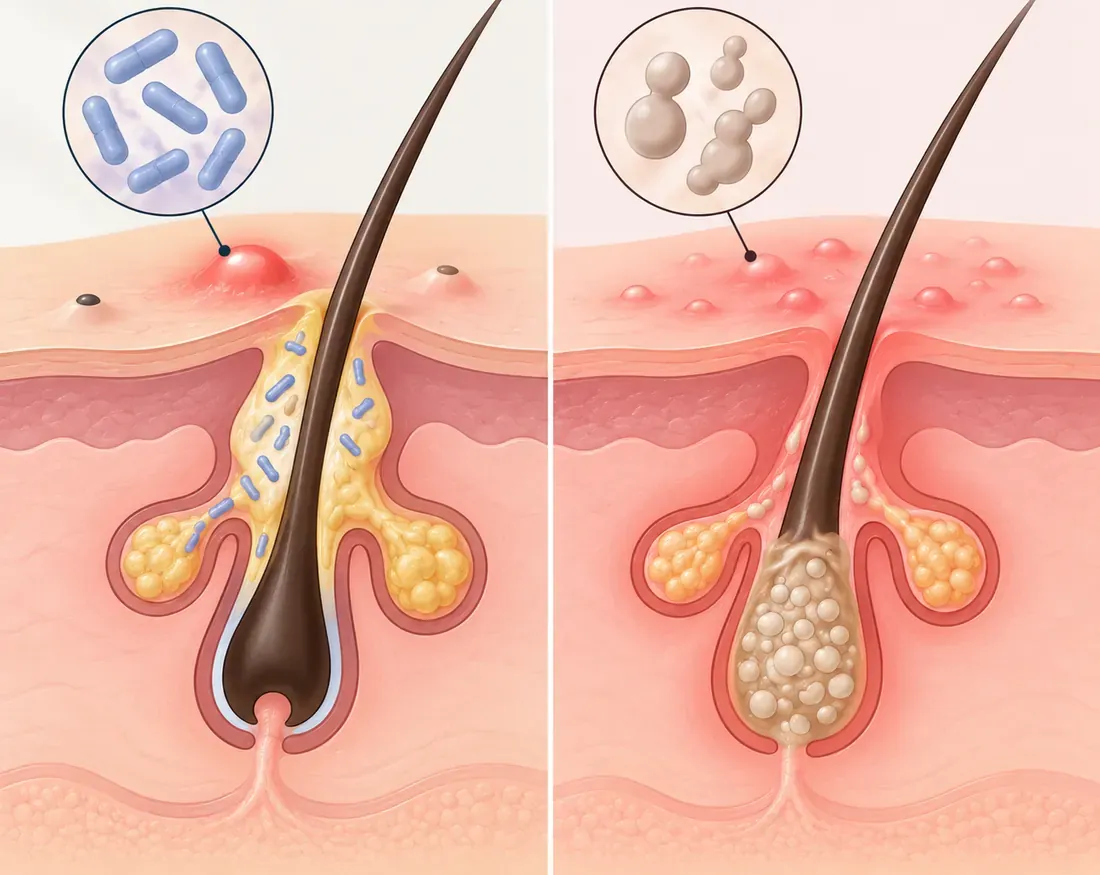
Which 5 signs point more towards fungal acne?
The following symptoms may point more towards Malassezia folliculitis than towards common acne:
Uniform spots
The spots are very similar in size and appearance.
Itching
The affected skin often itches.
No blackheads
The blackheads typical of common acne are not present.
Many lesions at once
Many small, spot-like lesions appear at the same time.
No improvement with acne treatment
The usual acne treatment brings no improvement, or the condition may even get worse.
These signs can help you recognise that this may not be common acne, but on their own they are not enough to establish a diagnosis. Malassezia folliculitis can also resemble other skin conditions, and it can even be present at the same time as acne vulgaris. That is why a dermatological examination is needed in the case of persistent or unclear symptoms.
How does fungal acne differ from rosacea or bacterial folliculitis?
Spot-like lesions can be caused by more than just common acne and fungal acne, so it is worth keeping other skin problems in mind during recognition as well:
- Bacterial folliculitis: this can also cause small, inflamed, pus-filled lesions on the trunk, and it is easily confused with Malassezia folliculitis. In a 2024 case report, a young patient's symptoms were first thought to be bacterial folliculitis, and only after antibiotic treatment proved ineffective did a mycological examination reveal that Malassezia was behind them.
- Rosacea: this typically affects the central part of the face, with persistent redness, a tendency to flush and visible blood vessels, while it does not usually appear on the trunk.
- Acne-like symptoms developing alongside the use of steroid-containing products: these can also involve uniform, spot-like lesions, which is why the doctor may ask about products used previously.
These skin problems can resemble one another and can even occur together. That is why, based on the appearance of the symptoms, in most cases only a suspicion can be formulated; a dermatological examination is needed to tell them apart with certainty.
Where does fungal acne appear most often?
Fungal acne appears most often on the chest, the back, the shoulders and the upper arms, but it can also affect the face, the forehead and the area around the hairline. It particularly favours areas where more sebum is produced, or where the skin sweats more easily.
The location of the symptoms alone does not prove that this is fungal acne. The appearance of the lesions, the itching and the absence of blackheads are also important clues in recognising Malassezia folliculitis.
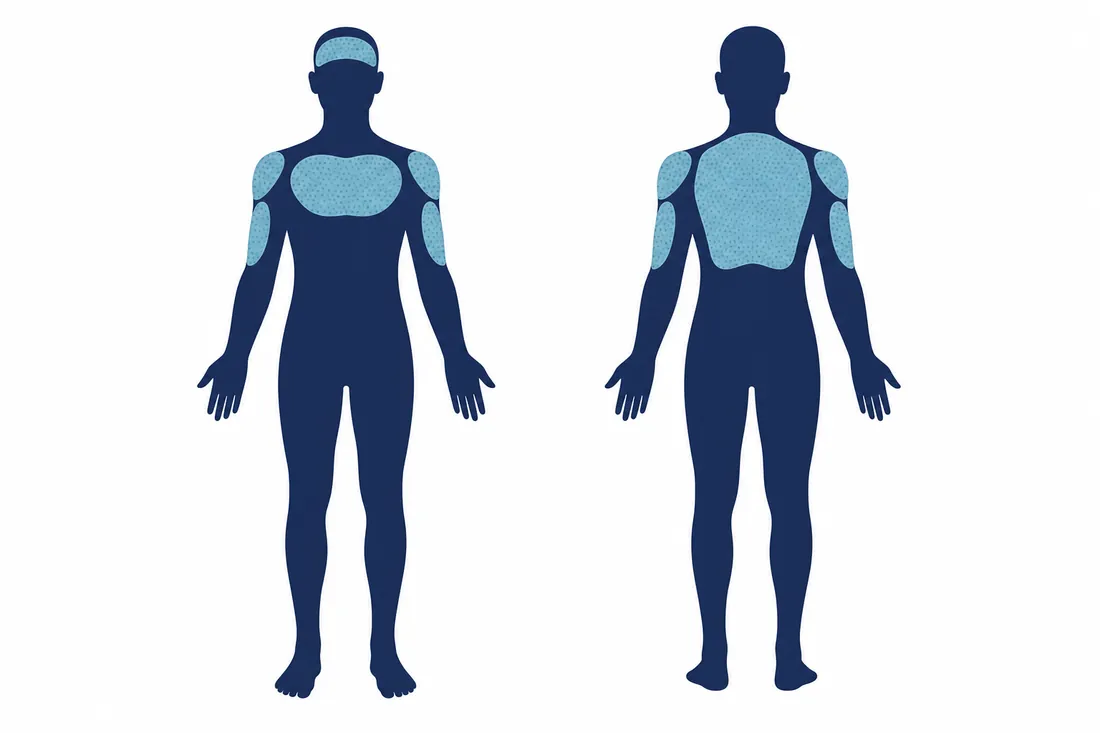
Fungal acne on the forehead and at the hairline
Fungal acne can also appear on the forehead and near the hairline, usually in the form of many small, similar-sized, spot-like lesions. This makes it easy to confuse with common acne on the forehead. Fungal acne may be indicated if the lesions itch, look very similar to one another, and there are no blackheads alongside them. Around the hairline, sweating and blockage of the skin can also create a favourable environment for the overgrowth of Malassezia.
Fungal acne on the face
Malassezia folliculitis can also develop on the face, although this is less typical than other parts of the body. Involvement of the face can be particularly misleading, because spot-like lesions usually make us think of common acne first. What is more, the two problems can be present at the same time. That is why, even with small spots on the face, it is not advisable to diagnose fungal acne on the basis of appearance alone.
Fungal acne on the back and shoulders
The back and the shoulders are among the areas most often affected by fungal acne. Here, larger numbers of small, uniform, red or pus-filled spot-like lesions can appear, and they often itch. Heat, sweating and clothing that clings tightly to the skin can create an environment that favours the overgrowth of Malassezia. As a result, the symptoms may become more noticeable in warm, humid weather or alongside intense exercise.
Fungal acne on the chest
The chest is also a typical location for Malassezia folliculitis. It can be characteristic that many small, very similar lesions appear within a short time, and they may be accompanied by itching.
Since common acne and other types of folliculitis can also develop on the chest, the location of the lesions is not enough for a definite diagnosis here either. If the symptoms are persistent, keep coming back or do not improve with the usual acne treatment, it is worth asking a dermatologist for help.
What causes fungal acne?
The overgrowth of Malassezia yeasts in the hair follicles may play a role in the development of fungal acne. These microorganisms are normally present on the skin as well, so their presence alone does not mean disease.
Certain circumstances, however, can favour their overgrowth. The literature most often mentions the following factors:
| Predisposing factor | What does it mean? | Why does it favour Malassezia? | What can you do? |
|---|---|---|---|
| Warm, humid environment | Summer heat, humid climate, sauna. | The fungus grows best in warmth and on moist skin. | Wash and change clothes as soon as possible after sweating. |
| Increased sweating | Exercise, physical work, tight clothing. | A persistently moist, closed environment develops on the skin. | Breathable, non-clinging clothes; a shower after training. |
| Higher sebum production | Oilier skin, sebum-rich areas of skin. | Malassezia uses lipids for its growth. | Non-occlusive skin care; this is only one factor among several. |
| Blockage of the hair follicles | Heavily covering creams, sunscreens, clinging clothes. | Inflammation can develop in the blocked follicle. | In the event of a flare-up, it is worth reviewing the products you use. |
| Antibiotic use | Previous or ongoing antibiotic treatment. | It can change the balance of the skin's microorganisms. | If the symptoms get worse alongside an antibiotic, tell your doctor. |
| Conditions affecting the immune system | Immunodeficient states, treatments affecting the immune system. | Overgrowth and inflammation develop more easily. | In such cases, medical assessment is always advisable. |
There is no single factor responsible: rather, the combined presence of several predisposing circumstances can increase the chance of it developing.
Why can Malassezia overgrow on the skin?
Malassezia does particularly well in an oilier, warm and moist environment. If conditions that are more favourable for it develop on the skin or around the hair follicles, it can overgrow more easily, which in some people can lead to inflammation.
Can sweating and warm weather make fungal acne worse?
Yes, they can contribute to the appearance or worsening of the symptoms. Research mentions warm, humid weather and increased sweating among the possible predisposing factors for Malassezia folliculitis.
This may also explain why in some people the symptoms can become more noticeable in summer, during exercise or with heavy sweating. On its own, however, this does not prove that Malassezia folliculitis is behind the spots.

Can antibiotics cause fungal acne?
The use of antibiotics can increase the risk of developing Malassezia folliculitis, but this does not mean that every antibiotic treatment causes fungal acne. Antibiotic use appears as a predisposing factor in several studies and literature reviews as well – including the 2023 European position statement and the 2026 review.
One possible explanation for this is that antibiotics can change the natural balance of the skin's microorganisms, which can create a more favourable environment for the overgrowth of Malassezia. For this reason, when symptoms treated as common acne do not improve or get worse alongside an antibiotic, the possibility of another diagnosis may arise.
Does oily skin matter?
Increased sebum production can be a predisposing factor. Malassezia uses lipids for its growth, and according to research, higher sebum production may play a role in the development of Malassezia folliculitis. This does not mean, however, that everyone with oily skin will necessarily develop fungal acne – sebum production may be only one of several predisposing factors.
Can certain cosmetics make the symptoms worse?
Certain cosmetics that heavily cover or occlude the skin can contribute to the development or flare-up of Malassezia folliculitis. The literature mentions such an occlusive effect – for example in the case of some skin care products and sunscreens – as a possible predisposing factor.
How is it confirmed that this is fungal acne?
The suspicion of fungal acne is formulated on the basis of the symptoms, but confirming it requires an examination. This is needed because Malassezia folliculitis and common acne can look similar: in that study of 320 people, in which the patients had been clinically diagnosed with acne, Malassezia folliculitis was ultimately confirmed in 28.8% of them as well.
According to the 2023 position statement of the European Academy of Dermatology and Venereology (EADV), direct microscopic examination is primarily recommended to confirm the suspicion: the dermatologist takes a sample from the hair follicle or from the contents of a pus-filled blister, which is transferred onto a slide, and the characteristic yeast forms are then looked for under the microscope.
According to the EADV position statement, microscopic confirmation is not a requirement in every case before starting topical antifungal treatment – among other reasons because this examination is not available at every care provider – but before treatment taken by mouth, confirming the diagnosis is recommended.
So if the symptoms do not improve, or it is not clear what is behind them, it is worth asking for a dermatological examination: its result can be used to decide which treatment may be appropriate.
How is fungal acne treated?
The treatment of fungal acne may depend on how extensive the symptoms are, how long they have been present, and whether this is a recurring problem. Treatment is usually based on antifungal medicines, but some active ingredients used to treat acne may also have a role.
Before choosing the appropriate treatment, however, it is important to make sure that Malassezia folliculitis really is behind the spot-like lesions. Since it is easily confused with common acne and other skin conditions, the wrong treatment can keep the problem going for a long time.
The table is an informative overview, not a treatment recommendation: which option is appropriate can be decided by a doctor on the basis of the symptoms.
Which antifungal treatments can be used?
Both topically applied and orally taken antifungal medicines may be considered in the treatment of fungal acne. Which of these may be appropriate can be weighed up on the basis of the severity and extent of the symptoms, among other things.
In certain cases, some active ingredients used to treat common acne – such as retinoids or benzoyl peroxide – may also be useful. Further research is needed, however, to clarify their exact role in Malassezia folliculitis.
How long does it take for fungal acne to improve?
The time to improvement can differ from person to person, so it is not possible to give an exact time in every case. It can be influenced, for example, by the severity and extent of the symptoms and by the treatment used. In a 2018 study, in which participants received antifungal treatment for four weeks, the number of lesions fell by at least half in 68.4% of those who completed the treatment.
If suspected fungal acne does not improve with treatment, it is worth reviewing the diagnosis as well. Malassezia folliculitis can resemble several other skin problems, and it can even occur together with common acne.
Why can fungal acne come back?
Fungal acne can recur even after successful treatment. One reason for this may be that Malassezia is naturally present on the skin, while the circumstances that favour its overgrowth – such as a warm, humid environment or increased sweating – can develop again later.
In recurring cases, the doctor may therefore also consider maintenance treatment. This does not mean, however, that everyone should use an antifungal product on a long-term basis.
What should you not do if you suspect fungal acne?
Do not automatically start antifungal treatment simply because your symptoms resemble a picture you have seen on the internet. Spot-like lesions can have several causes, and Malassezia folliculitis is easy to confuse with common acne, for example.
The 2026 literature review in the Journal of Drugs in Dermatology specifically draws attention to the fact that interest in "fungal acne", partly amplified by social media, can lead to unwarranted use of antifungal agents when there is no confirmed diagnosis. So if you suspect fungal acne, it is worth clarifying what is causing the symptoms with the help of a dermatologist before choosing the appropriate treatment.
Can fungal acne clear up on its own?
Fungal acne does not necessarily clear up on its own. Without treatment the symptoms can persist for a longer time, so in the case of persistent or recurring complaints it is worth consulting a dermatologist. The correct diagnosis is particularly important, since Malassezia folliculitis is often confused with common acne.
What can happen without treatment?
Without treatment, the itchy, spot-like lesions can persist or come back. And in the case of a mistaken diagnosis, the acne treatment used may not bring the expected improvement.
We write in detail about why the symptoms can return after successful treatment in the Why can fungal acne come back? section.
When is it worth seeing a dermatologist?
Since fungal acne is easily confused with common acne and other skin problems, it is worth seeing a dermatologist if the symptoms are persistent, keep coming back, or it is not clear what is behind them. An accurate diagnosis is also important because the treatment of acne vulgaris and Malassezia folliculitis can differ.
A dermatological examination may be particularly warranted if…
- you cannot decide whether this is common acne or folliculitis;
- the spot-like lesions itch;
- the symptoms affect a larger area of skin;
- the problem comes back regularly;
- it does not improve even with the usual anti-acne treatment;
- the symptoms appeared or got worse during or after antibiotic treatment;
- the complaints persist despite attempts at home skin care.
Since the treatment of acne vulgaris and Malassezia folliculitis can differ, the first step of the appropriate treatment is establishing exactly what kind of skin lesion this is. If you are unsure what is causing your spot-like lesions, at AIP Clinic's online dermatology consultation a specialist can assess the complaint and photos you submit, then give you a diagnosis and a personalised treatment plan; if needed, they can also issue a prescription. If a face-to-face examination or further investigation is needed, you will be informed about this as well.
Frequently asked questions about fungal acne
Is fungal acne contagious?
It is not considered a contagious skin disease in the classic sense. The Malassezia yeasts involved in its development can also be present naturally on healthy skin.
Can I have common acne and fungal acne at the same time?
Yes, Malassezia folliculitis and acne vulgaris can occur together. This can make it harder to tell the two conditions apart, so in unclear cases a dermatological assessment can be important.
How long does it take for fungal acne to clear up?
This varies from person to person, so no single timeframe applies to every case. In a 2018 study, after four weeks of antifungal treatment the number of lesions dropped by at least half in 68.4% of those who completed the treatment. If symptoms do not improve with treatment, it is worth reviewing the diagnosis as well.
How does a doctor establish that it is fungal acne?
A dermatologist raises the suspicion based on the appearance of the lesions and the medical history, and that suspicion can be confirmed by direct microscopy: a sample taken from the follicle or from the contents of a pustule is examined for the yeasts. Examination under Wood's lamp can also help.
Can fungal acne leave scars?
Scarring is not among the most characteristic signs of Malassezia folliculitis, although a change in skin colour can remain after the inflammation. Scratching the skin increases the chance that visible marks are left behind.
Can I wear make-up if I have fungal acne?
Not every cosmetic is a problem, but heavily covering products that occlude the skin may contribute to symptoms getting worse. If your symptoms regularly worsen after using a particular product, it may be worth avoiding it.
Can stress make fungal acne worse?
There is currently not enough evidence that stress is a direct cause of Malassezia folliculitis. The literature points to much clearer risk factors: heat, humidity, sweating and occlusion of the skin.
Is fungal acne more common in teenagers?
It can often appear in teenagers and young adults, but it does not affect only that age group. In young people it can occur alongside common acne.
Can fungal acne appear on the scalp?
Malassezia can also play a part in other conditions of the scalp, but symptoms in that area do not automatically mean fungal acne. A dermatological assessment may be needed to establish the exact cause.
Can fungal acne be related to dandruff?
Malassezia yeasts can be involved in the development of both conditions, but they are two different skin problems. The presence of dandruff alone therefore does not prove that pimple-like lesions are caused by Malassezia folliculitis.
Fungal acne or acne? For the right treatment, you first need to find the underlying cause
Fungal acne and common acne can easily look similar, but their background and their treatment can differ. That is precisely why it is not advisable to start self-diagnosing or treating at home on the basis of the appearance of the spots alone. The first step of the appropriate treatment is clarifying exactly what is causing the skin symptoms.
Spot-like skin lesions are not always caused by the same problem: only once the exact cause has been clarified can it become clear which treatment really leads to results.
This article is for information purposes and does not replace specialist medical examination, diagnosis or treatment. In the case of persistent or recurring skin symptoms, consult your general practitioner or a dermatologist.
Sources used
- Paichitrojjana A, Chalermchai T. The Prevalence, Associated Factors, and Clinical Characterization of Malassezia folliculitis in Patients Clinically Diagnosed with Acne Vulgaris. Clin Cosmet Investig Dermatol. 2022;15:2647–2654. (n=320; MF prevalence 28.8%; odds of itching 7.38×) – pubmed.ncbi.nlm.nih.gov
- Pürnak S, et al. The Prevalence of Malassezia Folliculitis in Patients with Papulopustular/Comedonal Acne, and Their Response to Antifungal Treatment. Skinmed. 2018;16(2):99–104. (n=217; MF 25.3%; after 4 weeks of antifungal treatment, ≥50% improvement in 68.4% of those who completed it) – pubmed.ncbi.nlm.nih.gov
- Martínez-Ortega JI, Mut Quej JE, Franco González S. Malassezia Folliculitis: Pathogenesis and Diagnostic Challenges. Cureus. 2024;16(11):e73429. – pmc.ncbi.nlm.nih.gov
- Henning MAS, Jemec GB, Saunte DML. [Malassezia folliculitis]. Ugeskr Laeger. 2020;182(47):V08200572. – pubmed.ncbi.nlm.nih.gov
- Malassezia Folliculitis Presentation, Diagnosis, and Treatment: A Review of "Fungal Acne". J Drugs Dermatol. 2026. – pubmed.ncbi.nlm.nih.gov
- Henning MAS, et al. Position statement: Recommendations on the diagnosis and treatment of Malassezia folliculitis. J Eur Acad Dermatol Venereol. 2023;37(7):1268–1275. – pubmed.ncbi.nlm.nih.gov
- Niode NJ, et al. Clinico-laboratory findings of Malassezia folliculitis in Indonesia: A multicentre study. Mycoses. 2022;65(10):953–959. (n=353; itching 83.9%; truncal localisation 68.3%) – doi.org