
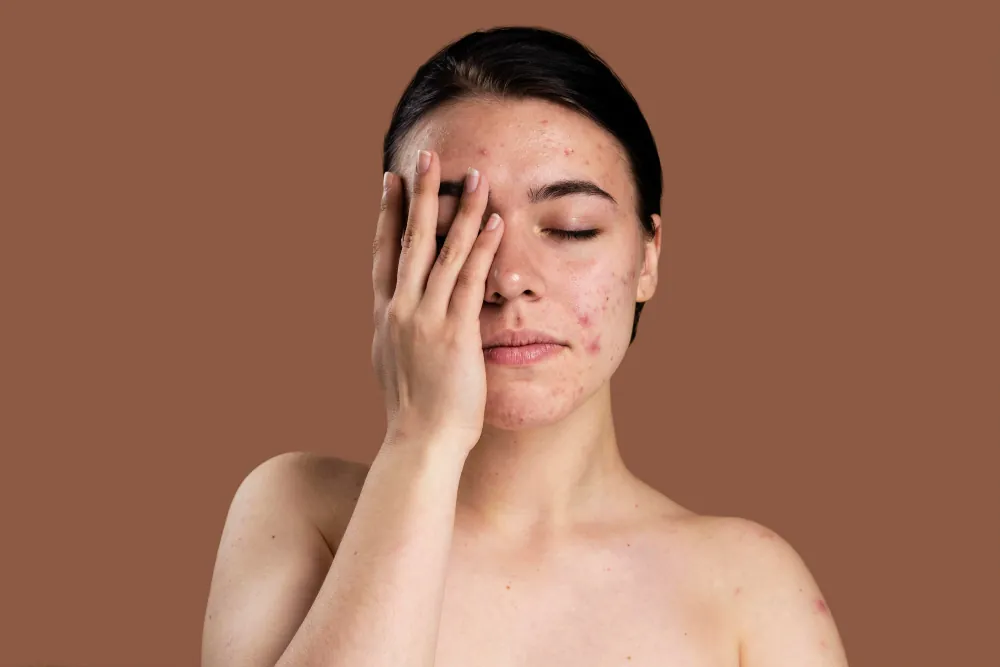
Acne (Latin: acne vulgaris) is a chronic, inflammatory skin disease that primarily affects the hair follicles and sebaceous glands – blackheads, whiteheads and pimples appear on various parts of the body. Acne is also a complex skin disease because a great many influencing factors determine how severe it becomes. These include excess sebum production, genetics, hormonal balance, lifestyle and the strength of the immune system. In this article you can read in detail about the causes, symptoms and possible treatment options for acne.
In brief
- Acne is a disease, not a hygiene issue – it does not develop because someone does not wash their face often enough.
- Four processes lie behind it: excess sebum production, clogging of the hair follicles, altered functioning of the skin microbiome and inflammation.
- Not every pimple is acne: rosacea, folliculitis and perioral dermatitis can resemble it – but their treatment differs.
- Treatment is measured in weeks: the first visible improvement typically takes 6–8 weeks, and a result that can be properly assessed takes 2–3 months.
- For deep, painful or scarring acne it is worth seeing a dermatologist rather than experimenting with products at home.
What is acne, and how does it differ from a simple pimple?
Put very simply: acne is a complex skin disease, and a pimple is one of its possible symptoms. It is important to note, however, that the occasional pimple is not the same as acne. A pimple can develop, for example, because of a single clogged pore, whether as a result of inadequate facial cleansing or after eating greasier, sugarier food.
What does acne vulgaris mean?
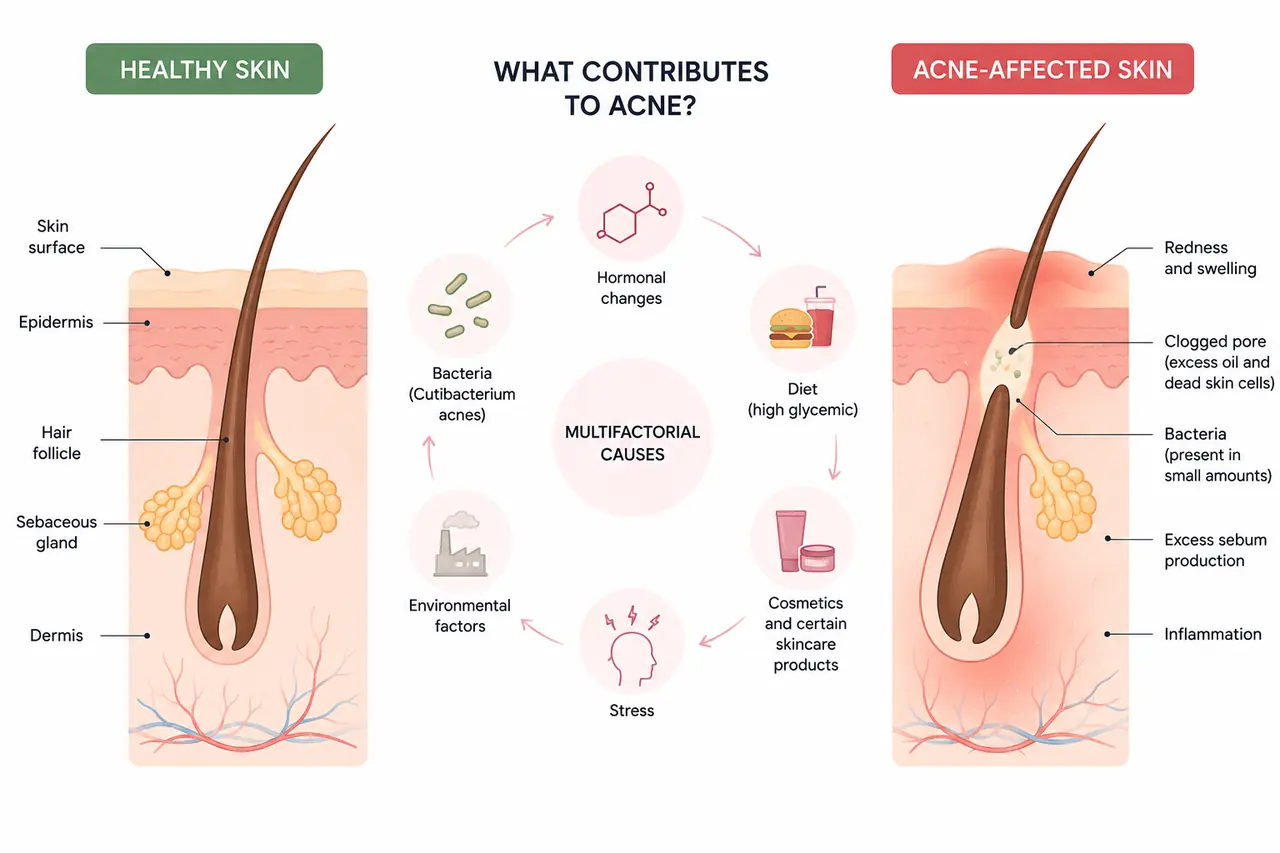
Acne affects the hair follicles and sebaceous glands of the skin. Beneath the skin, the pores are connected to glands that produce sebum – an oily substance. The glands and pores are connected by the hair follicle, a thin canal from which a fine hair grows out to the surface of the skin. When sebum and dead skin cells clump together, they clog the hair follicle. The bacteria that accumulate as a result cause inflammation, which leads to the characteristic red, inflamed pimples of acne.
Acne affects roughly this proportion of the world's total population, making it the eighth most common skin disease.
This is how common acne is among 12–24-year-olds, and the disease can persist into adulthood.
Where does acne most commonly appear?
Acne most commonly appears on the face, forehead, chin and along the jawline, but pimples can also develop on the back, chest and shoulders. One reason for this is that these areas contain many sebaceous glands. Acne does not, however, appear in the same place and in the same form in everyone: there may be small blackheads and whiteheads, inflamed pimples, pus-filled lesions or even deeper, painful lumps.
The most common sites of acne:
Face
One of the most common sites of acne. The nose, cheeks, forehead, chin and jaw area can all be affected.
Forehead
Blackheads, small closed comedones and inflamed pimples can be common here, especially on oilier skin.
Chin and jawline
Recurring, sometimes deeper and more painful pimples can develop in this area too. Location alone, however, is not enough to diagnose hormonal acne, for example.
Back
Acne on the back – often referred to as bacne – can take various forms, from blackheads and whiteheads to inflamed pimples and deeper lumps.
Chest
Acne can also develop on the chest, an area rich in sebaceous glands. It is important, however, to distinguish it from other pimple-like skin conditions, such as folliculitis.
Shoulders
Pimples on the shoulders and upper back can be aggravated by sweating, friction and occlusion, among other things.
Do pimple, comedo and acne mean the same thing?
No. Acne, pimples and comedones are related but not identical concepts.
We describe the difference between open and closed comedones in detail in the chapter What types of acne are there?.
In short: acne is the skin disease itself, while comedones and inflamed pimples are among the possible skin lesions that appear in the course of acne.
What causes acne?
There is no single cause of acne. It is a complex skin disease influenced by several factors, in which the functioning of the sebaceous glands, the clogging of the hair follicles, changes in the skin microbiome and inflammation all play a role.
Four fundamental processes are particularly important in the development of acne:
Excess sebum production
The sebaceous glands become more active and produce more sebum than usual – androgen hormones also play a role in this.
Clogging of the hair follicles
Keratinised skin cells accumulate in the hair follicle and, mixing with sebum, form a plug.
Cutibacterium acnes and the microbiome
A natural inhabitant of the skin which, in a clogged, sebum-rich hair follicle, can enter into an altered interaction with the immune system.
Inflammatory processes
The characteristic red, tender or pus-filled lesions develop as a result of the immune response.
These are closely interconnected. In addition, genetic predisposition, hormonal changes, certain medicines and cosmetics, diet, stress and some environmental influences can also affect the development or severity of acne.
How does a pimple develop?
The development of a pimple can begin long before anything is visible on the surface of the skin.
The process takes place in the pilosebaceous unit, that is, the system made up of the hair follicle and the sebaceous gland attached to it. Normally, the sebum produced by the sebaceous gland reaches the surface of the skin through the hair follicle.
In acne-prone skin, however, several processes can change at the same time:
The pathway to acne
excess sebum production → accumulation of dead skin cells → clogging of the hair follicle → formation of a comedo → inflammation
The bacterium Cutibacterium acnes also plays a role in the process, particularly in the development of inflammatory acne.
Why is excess sebum production important in the development of acne?
Sebum is a natural, oily substance produced by the sebaceous glands. It plays an important role in protecting the skin, so the presence of sebum in itself is not a problem.
In acne-prone skin, however, the sebaceous glands can become more active and produce too much sebum.
Hormones, especially androgens, play a significant role in this. This partly explains why acne becomes particularly common during adolescence and why its condition can change during hormonal fluctuations.
Excess sebum production alone does not necessarily cause acne. If, however, dead skin cells also accumulate in the hair follicle, clogging can develop more easily.
How do pores become clogged?
In healthy skin, the skin cells lining the hair follicle are continuously renewed and shed.
In acne-prone skin, however, this process can change. Keratinised skin cells can accumulate in the hair follicle, where they mix with sebum and can form a plug.
This process is called follicular hyperkeratinisation.
The resulting blockage can give rise to a comedo: if the opening of the hair follicle stays open, an open comedo, or blackhead, can develop; if the opening is closed, we speak of a closed comedo, or whitehead.
What role does Cutibacterium acnes play in the development of acne?
Cutibacterium acnes (C. acnes) – formerly known as Propionibacterium acnes – is naturally found on human skin. Its presence therefore does not in itself mean infection, nor is it true that acne develops simply because there are “too many bacteria on the skin”.
The bacterium thrives particularly well in sebum-rich hair follicles. If a hair follicle becomes clogged and a large amount of sebum accumulates in it, an environment can arise that may contribute to changes in the interactions between C. acnes and the immune system.
As a result, various inflammatory processes can be set in motion.
This is why, today, the development of acne is not interpreted as a simple bacterial infection. The skin microbiome, certain strains of C. acnes and the reaction of the immune system may all play a role together.
How does an inflamed pimple develop?
The next important element in the development of acne is inflammation.
The immune system can also react to the processes taking place in the clogged hair follicle. As a consequence, inflammation can develop in the surrounding tissue, which becomes visible from the outside.
This is when the characteristic red, tender papules, pus-filled pustules and deeper, painful nodules can appear.
In more severe inflammation, the wall of the hair follicle can also be damaged and its contents can spill into the surrounding tissue. This can further intensify the inflammatory reaction.
Deeper and more strongly inflamed acne lesions carry a higher risk of permanent scarring, which is why this type of acne should not be treated with home methods alone for long periods.
What factors can influence the development of acne?
The four processes described above explain what happens in the skin when acne develops. These must, however, be distinguished from the factors that can influence these processes.
What role do hormones play in the development of acne?
Hormonal changes can significantly affect the functioning of the sebaceous glands. Androgen hormones in particular can increase sebum production.
This is why acne often appears or can worsen during the teenage years, in certain phases of the menstrual cycle, during hormonal changes and in certain hormonal conditions.
This does not mean, however, that all acne is hormonal in origin.
Can a predisposition to acne be inherited?
Genetic predisposition can also play a role in the development of acne. If others in the family – especially the parents – have had more severe acne, the predisposition to acne may be greater.
An inherited predisposition does not, however, mean that acne will definitely develop, nor that its severity is predetermined.
Can diet affect acne?
The relationship between diet and acne is more complex than simply labelling certain foods as “pimple-causing”.
Based on research, a high glycaemic load diet and the consumption of certain dairy products have received the most attention. The association is not the same in everyone, however, so there is no universal “acne diet” that would eliminate pimples in everyone.
Chocolate, a hamburger or a glass of milk cannot in itself be regarded as a direct cause of acne.
Can stress make acne worse?
Stress should not be treated as a direct cause of acne either. At the same time, prolonged or intense stress can contribute to the worsening of existing acne in some people.
Hormonal and inflammatory processes, as well as indirect factors – such as changes in sleep or skincare habits – can all play a part in this.
Can cosmetics cause pimples?
Certain cosmetics and skincare products can clog the pores or worsen the condition of acne-prone skin, especially if the product in question is not suitable for the skin type concerned.
At the same time, having acne-prone skin does not mean that every oily or richer cosmetic must automatically be avoided.
It is worth choosing products that are suitable for acne-prone skin, and avoiding over-cleansing, scrubbing or drying out the skin.
Can environmental factors affect acne?
The skin is constantly exposed to external environmental influences. High humidity, heat, sweating, air pollution, friction or contact with certain substances at work can, in some cases, contribute to the development or worsening of acne.
Their effect varies from person to person, however, so environmental factors are better regarded as influencing or aggravating factors rather than as a universal cause of acne.
In short: what happens in acne-affected skin?
The development of acne in one sentence
excess sebum production + altered keratinisation → clogged hair follicle → altered interactions between C. acnes and the skin microbiome → inflammation → acne lesions
This process can be influenced to varying degrees by hormones, genetic predisposition, diet, stress, certain cosmetics, medicines and environmental factors.
This is why, when treating acne, it is not enough simply to “dry out the pimples” or remove the sebum. Depending on the type and severity of the acne, the aim of effective treatment is to target one or more of the processes involved in the development of acne.
What types of acne are there?
Acne does not present in the same way in everyone. Some people mainly have blackheads and whiteheads, while others develop red, inflamed pimples, pus-filled lesions or deep, painful lumps. What is more, several types of acne lesion can occur at the same time on the same area of skin.
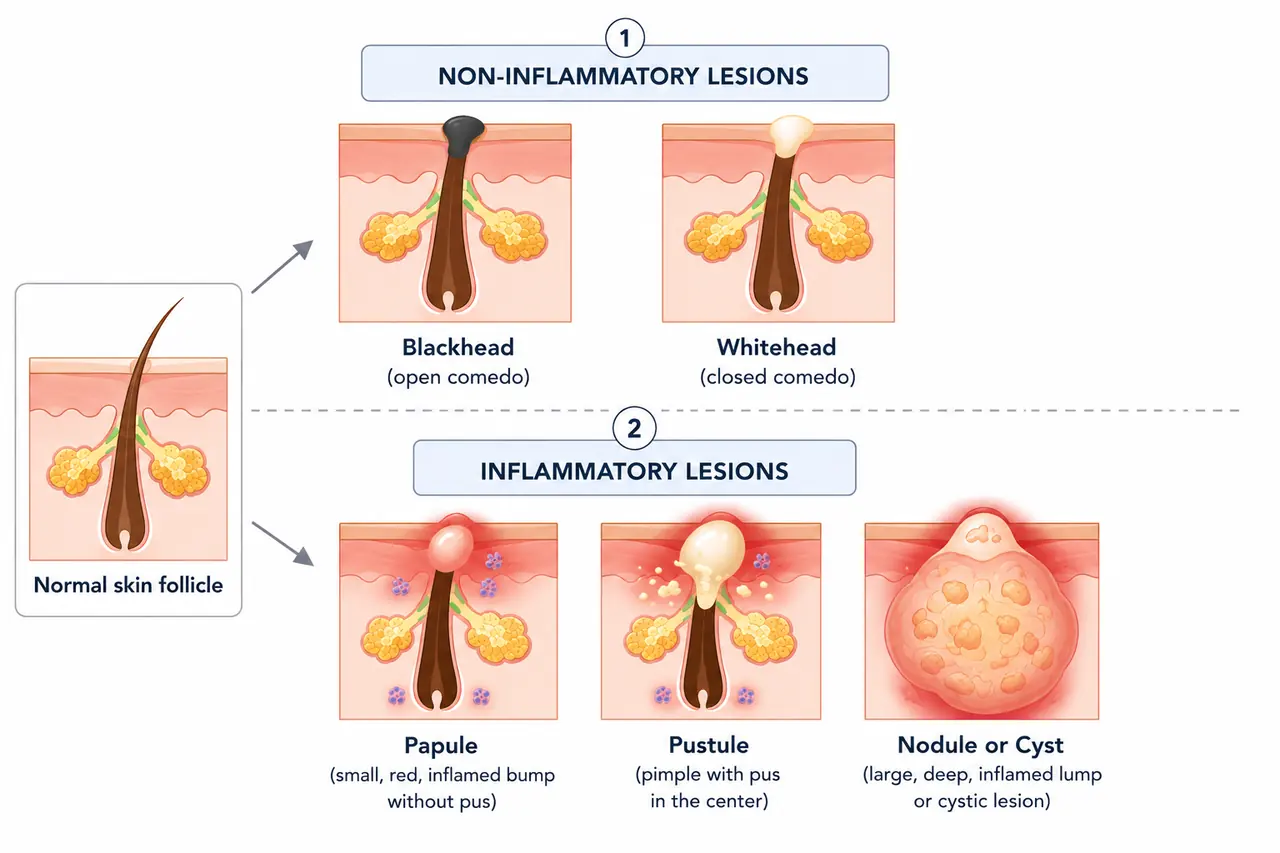
The most common form is acne vulgaris, whose lesions can essentially be divided into two main groups:
- non-inflammatory lesions: open and closed comedones, that is, blackheads and whiteheads;
- inflammatory lesions: papules, pustules and deeper nodules.
The deeper the inflammation in the skin, the greater the risk of persistent discolouration and acne scarring.
What type of acne might you have?
The table is for guidance only: several types of lesion can be present on one area of skin at the same time, and this classification does not replace examination by a specialist.
What is the difference between open and closed comedones?
A comedo – a blackhead or whitehead in everyday language – develops when sebum and keratinised skin cells accumulate in the opening of the hair follicle. Comedones are the non-inflammatory lesions of acne, and two basic types are distinguished: the open and the closed comedo.
In the case of an open comedo, or blackhead, the opening of the hair follicle stays open. The material accumulated inside it comes into contact with the air and turns dark because of oxidation processes on its surface.
It is therefore important to clear up a common misconception: a blackhead is not black because dirt has got into the pore, and its development is not a sign of inadequate washing.
In the case of a closed comedo, or whitehead, by contrast, the opening of the hair follicle stays closed. Sebum and keratinised skin cells accumulate beneath the skin surface, so a small, whitish or skin-coloured bump is visible.
In short: a similar process lies behind blackheads and whiteheads. The main difference is that a blackhead is an open comedo and a whitehead is a closed comedo.
What is a papule?
A papule is a small, inflamed acne lesion that is usually red or pinkish, raised above the skin surface, and may be tender or painful to the touch.
A papule can develop when an inflammatory reaction starts around the clogged hair follicle. As a result, the skin can become red and swollen.
Papules should not be squeezed. Since they have no easily removable “contents”, squeezing can further damage the surrounding tissue and increase the inflammation.
What is a pustule?
A pustule is an inflamed acne lesion that contains pus. It usually has a red, inflamed base and a clearly visible white or yellowish centre.
This is what is often simply called a pus-filled pimple in everyday language. Pustules most commonly appear on the face, back, chest and shoulders.
Papule or pustule?
papule → inflamed, red pimple without pus
pustule → inflamed pimple with visible pus in the centre
What is nodular acne?
Nodular acne is a more severe, inflammatory form of acne characterised by larger, hard and often painful lumps – known as nodules – that develop in the deeper layers of the skin.
Nodular acne often appears on the face, around the jawline, on the back or on the chest.
Because the inflammation also affects the deeper layers of the skin, there is a greater risk of scarring and permanent skin changes.
Deep, painful lumps in particular should not be squeezed. Pressure can further increase tissue damage and inflammation.
If deep, painful lumps appear regularly, it is worth seeing a dermatologist, because nodular acne often requires treatment that goes beyond general, over-the-counter anti-acne products.
What is cystic acne?
The term “cystic acne” is generally used to describe a severe condition involving deeply inflamed, painful acne lesions. It is often mentioned together with nodular acne, which is why you may also come across the term nodulocystic acne.
Here, however, it is worth clarifying a common oversimplification: the lesions called “cysts” in acne are not always true cysts in the histological sense. For this reason, the modern medical literature often speaks more precisely of deep inflammatory nodules or nodulocystic acne.
These lesions lie deep in the skin, can be larger than ordinary pimples, can be severely inflamed and often painful, can persist for a longer time and can significantly increase the risk of scarring.
Severe, nodular or nodulocystic acne should be treated by a dermatologist, especially if the lesions are painful, leave scars behind or the condition keeps getting worse.
What does hormonal acne mean?
Hormonal acne is not a separate type of acne lesion like a comedo or a pustule. The term refers to acne in whose development or worsening hormonal changes play a significant role.
Androgen hormones in particular can affect the functioning of the sebaceous glands and increase sebum production.
A hormonal influence may be suggested, for example, if the acne appears or worsens at certain stages of life, flares up regularly in connection with the menstrual cycle, persists into adulthood, or occurs together with other symptoms suggesting a hormonal imbalance.
In adult women, the chin, jawline and lower face are often affected, but the location of the acne alone does not prove that the problem is hormonal in origin.
In other words, a pimple on the chin does not automatically mean hormonal acne.
What does adult acne mean?
Adult acne is acne that persists into adulthood or appears for the first time in adulthood. Essentially, there are two situations:
- Persistent adult acne: acne that began in adolescence does not clear up completely in adulthood.
- Late-onset acne: someone had no significant acne as a teenager, but the lesions appear later, as an adult.
The same fundamental processes – excess sebum production, clogging of the hair follicles, changes in the skin microbiome and inflammation – also lie behind adult acne, but these can be affected by hormonal, genetic, lifestyle, medication-related and environmental factors as well.
In the case of acne that appears suddenly or persists in adulthood, it can be particularly important to check whether it really is acne vulgaris, since several other skin diseases – such as rosacea, folliculitis or perioral dermatitis – can also cause pimple-like lesions.
You can read more about the causes of breakouts after the age of 25, the hormonal changes after 30 and 40, and the treatment options in a separate article: Adult acne: why does it develop, and how can it be treated?
How do I know whether I really have acne?
Not every red bump, blackhead-like spot or “pimple” automatically means acne. There are several skin problems that can look very much like acne at first glance – especially when they appear on the face, back or other areas prone to pimples.
One of the most important clues is what type of lesions appear, where they are located, whether they itch or hurt, and whether there are blackheads or whiteheads alongside them.
Acne vulgaris is characterised by the fact that several types of lesion can be present at the same time: blackheads and whiteheads, red papules, pus-filled pustules and, in more severe cases, deeper, painful lumps.
If, on the other hand, every “pimple” looks almost exactly the same, itches intensely, appears in an unusual place, or is accompanied by other symptoms – such as persistent redness, a burning sensation or flaking – it is worth considering that it may not be classic acne.
What can resemble acne?
The skin problems most easily confused with acne include folliculitis (inflammation of the hair follicles), rosacea and perioral dermatitis. In certain cases, deep, painful, recurring “pimples” may also be caused by hidradenitis suppurativa.
There are, however, a few simple differences that can help you tell them apart:
| Acne | Folliculitis | Rosacea | Perioral dermatitis | |
|---|---|---|---|---|
| Blackheads/whiteheads | Common | Usually absent | Absent | Absent |
| Pus-filled lesions | Possible | Possible | Possible | May occur |
| Itching | Not typical, but may occur | More common | More of a burning/stinging sensation | May burn or itch |
| Persistent facial redness | Not typical | Not typical | Very characteristic | The affected area may be red |
| Typical location | Face, back, chest, shoulders | Hair-bearing areas too | Centre of the face | Around the mouth and nose |
This is of course not suitable for self-diagnosis, but it shows clearly why not every pimple-like lesion should automatically be treated as acne.
What is the difference between acne and folliculitis?
Folliculitis, or inflammation of the hair follicles, is perhaps one of the conditions most easily confused with acne. It can cause small red or pus-filled bumps that really can look like a cluster of pimples.
The most important difference is that in folliculitis it is the hair follicle itself that becomes inflamed. The lesions therefore often appear around individual hairs and are frequently quite uniform.
Acne, by contrast, is usually more “varied”: blackheads and whiteheads, smaller red pimples, pustules and deeper lumps can all be present side by side.
Another telltale sign can be itching. Folliculitis may itch or be tender, whereas in acne it is more the pain of deeper, inflamed pimples that is characteristic.
Several factors can play a role in the development of folliculitis, such as bacteria or yeasts, and sweating, shaving, friction and tight clothing can also contribute.
When should you suspect folliculitis?
If the “pimples” are very similar in size and appearance, appear around hair follicles, itch, and you see no blackheads or whiteheads alongside them.
What is the difference between acne and rosacea?
Rosacea and acne are particularly easy to confuse, because both can cause red, inflamed, even pus-filled-looking lesions on the face. There is, however, one very important difference: in rosacea there are none of the comedones – that is, blackheads and whiteheads – characteristic of acne.
Rosacea typically affects the central part of the face – for example the cheeks, nose, forehead and chin. Alongside the pimple-like lesions, persistent or recurring facial redness, a burning, stinging sensation, sensitive skin and small visible blood vessels may also be common.
It can also be characteristic for the facial redness to intensify suddenly in certain situations. In some people, for example, heat, sunlight, alcohol, spicy food or stress can provoke the symptoms.
And here it is important to clarify an old name too: you may come across the term “acne rosacea” on the internet, but this is misleading. According to the current understanding, rosacea is not a type of acne but a separate skin disease.
What is the difference between acne and perioral dermatitis?
If small red pimples appear mainly around the mouth, it is easy to assume that the face has simply developed acne. Yet it may be perioral dermatitis.
Perioral dermatitis usually presents with many small, red or skin-coloured bumps around the mouth, but it can also develop beside the nose and even around the eyes. At the same time, the skin may be red, dry or flaky, and a burning, tight or itching sensation may also occur.
One of its interesting characteristics is that a narrow, symptom-free band of skin often remains directly next to the lips.
In acne, by contrast, comedones are common, and it is usually not only the area around the mouth that is affected.
Certain topically applied corticosteroids, as well as certain cosmetics and skincare habits, can be particularly important in the development or worsening of perioral dermatitis.
This matters because if perioral dermatitis is mistaken for acne and we try to “dry it out” with more and more strong active ingredients, the irritation of the skin may become even worse.
When might a “pimple” actually be hidradenitis suppurativa?
There is one situation in which it is particularly important not to treat recurring “pimples” as simple acne.
Hidradenitis suppurativa (HS) is a chronic, inflammatory skin disease that can cause deep, painful lumps and abscesses. These are easily mistaken for very large, deep pimples or ingrown hairs.
The most important difference is often the location and the recurrence. Hidradenitis suppurativa typically appears in areas where skin touches skin: in the armpits, around the groin, around the buttocks, on the inner thighs or under the breasts.
The lumps often recur in the same area, can be painful, and may open up and discharge. Over a longer period, scarring and connecting channels under the skin, known as tunnels, can also develop.
This is therefore a completely different situation from the occasional pimple appearing on the face or back.
It is especially worth seeing a doctor if deep, painful “pimples” or abscess-like lumps keep reappearing in the same skin-fold area, particularly if they scar or discharge.
Not sure whether it really is acne? Pimple-like skin lesions are not always caused by acne. Rosacea, folliculitis, perioral dermatitis or another skin problem can cause similar symptoms, and for the right treatment it is important to know exactly what you are dealing with. With AIP Clinic's online dermatology assessment you do not have to guess: you send photographs of the skin problem and the necessary information, and a specialist evaluates your case.
How can acne be treated effectively?
The short answer: there is no single treatment for acne that works equally well for everyone. A few blackheads or the occasional pimple may require a completely different treatment from regularly recurring, inflamed or deep, painful acne.
When choosing the right treatment, therefore, the type and severity of the acne, the affected area of skin and whether it leaves marks or scars behind all matter.
What is more, good treatment does not only try to remove the pimples that are already there. The aim is also for fewer new pimples to develop, for inflammation to decrease and, where possible, to prevent scarring.
What topical treatments are there for acne?
For mild to moderate acne, treatments applied directly to the skin are often the first step. These may be gels, creams, washes or other products. The best-known anti-acne active ingredients include retinoids, benzoyl peroxide, salicylic acid and azelaic acid. It does matter, however, which one is used for what.
Here too, however, more is not necessarily better. If we start using three exfoliants, a retinoid and several “pimple-drying” products at once, the skin easily becomes irritated and sensitive, while the acne does not necessarily improve any faster.
Why are several treatments combined?
Several processes are involved in the development of acne at the same time. For this reason, in many cases active ingredients that work in different ways are combined, rather than expecting a single product to solve every problem – international dermatology guidelines also emphasise the role of combined topical treatments.
For example, one active ingredient can help prevent the pores from clogging, while another acts primarily on the inflammation or on the role of Cutibacterium acnes.
The right combination, however, should be chosen based on the type and severity of the acne.
When might antibiotics be needed?
If the acne is severely inflamed, moderate or severe, the doctor may also recommend the use of antibiotics.
There are both topical and oral antibiotics. According to professional guidelines, oral antibiotics are used primarily for moderate or severe inflammatory acne, when a larger area of the body is affected, or when topical treatment has not produced an adequate result.
With antibiotics, the question of antibiotic resistance is particularly important. For this reason, it is not a good idea to use antibiotics on individual pimples on your own initiative, and they are not used for an unlimited time in the treatment of acne either. One of the aims of combination treatment is precisely to reduce the risk of resistance.
When might hormonal treatment be considered?
In some women, hormonal influences can also play an important role in the development of acne. In such cases, the doctor may in some instances also consider hormonal treatment – for example certain contraceptive preparations. Spironolactone can also be used in certain cases.
It is important, however, that a few pimples on the chin do not automatically mean that it is a case of “hormonal acne”.
The need for hormonal treatment must always be assessed individually by a specialist, and its effect does not appear overnight either.
When might treatment with isotretinoin be needed?
If the acne is severe, deep and inflamed, causes scarring, or does not improve adequately despite other treatments, the doctor may consider isotretinoin treatment.
Isotretinoin is a vitamin A derivative that acts on several important processes in the development of acne, including significantly reducing sebum production.
It can be a very effective treatment, but it is not simply a “stronger anti-pimple tablet”. Because of its side effects, it requires medical supervision and regular monitoring.
The question of pregnancy is particularly important, since isotretinoin can seriously harm the unborn baby. For this reason, strict rules apply to its use.
When should you see a dermatologist about acne?
There is no need to wait until the acne becomes very severe. It is especially worth seeking professional help if deep or painful lumps appear, the acne leaves scars, it affects a larger area of skin, previously tried treatments are not working, or you are simply not sure whether it really is acne.
A specialist can also help you avoid trying different products at random for months on end, and instead receive an appropriate treatment direction based on the type and severity of your acne.
What skincare routine is recommended for acne-prone skin?
When caring for acne-prone skin, it is easy to fall into the trap of thinking that the more anti-pimple products we use, the faster the result will be. In reality, it is often precisely the simpler routine that works better.
The aim is not to “dry out” the skin at all costs, but to cleanse it gently, moisturise it properly and protect it from the sun, while also giving the active ingredients chosen to treat the acne time to work.
If you are using a specific acne medicine or active ingredient, always adjust the routine accordingly, because not every product needs to be applied in the morning.
What should you use to cleanse acne-prone skin?
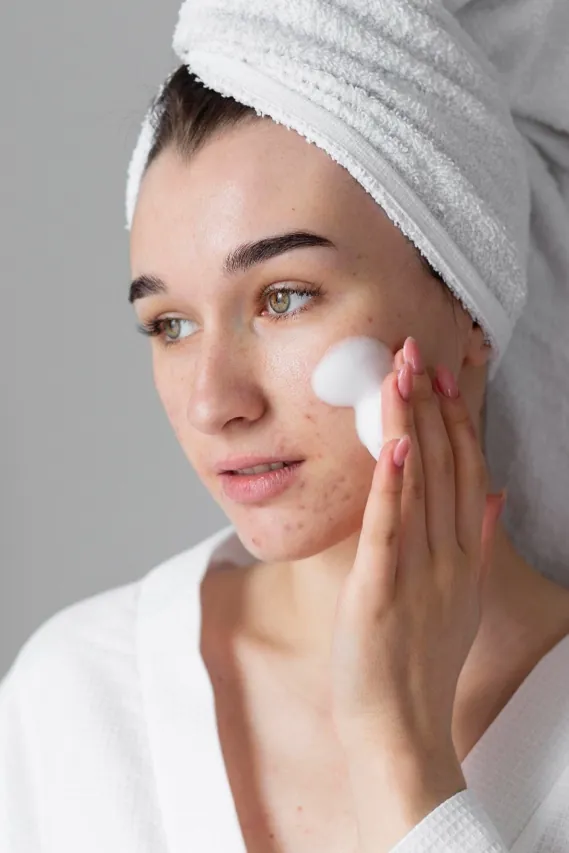
For acne-prone skin, it is worth choosing a gentle facial cleanser that removes sebum, sweat, make-up and sunscreen without severely drying out the skin.
Cleansing twice a day – morning and evening – is generally sufficient, and it is also worth washing your face after heavy sweating.
What you do not need to do: scrub hard, use exfoliating scrubs or wash your face five times a day. Acne does not develop because the skin is “dirty”, and excessive cleansing can irritate it.
Does oily, acne-prone skin need moisturising?
Yes. Oily skin needs moisturising too.
This may sound strange at first: if my face is already shiny, why do I need cream? Sebum production and skin hydration, however, are not the same thing.
What is more, several anti-acne active ingredients – such as retinoids or benzoyl peroxide – can dry and irritate the skin. A light moisturiser suitable for acne-prone skin can help counteract this and support the skin barrier.
What sunscreen should you use on acne-prone skin?
Sunscreen is not a step to skip for acne-prone skin either. It can be particularly important if you are using a treatment that can make the skin more sensitive, or if red or brown marks remain after the pimples.
It is worth choosing a broad-spectrum sunscreen of at least SPF 30. If your skin becomes oily or clogged easily, look for a light-textured product that is also suitable for acne-prone skin.
And yes: sunscreen matters in winter and in cloudy weather too, not just on holiday.
Is it OK to exfoliate acne-prone skin?
You can, but do not overdo it.
Certain chemical exfoliants – such as salicylic acid – can help treat clogged pores and blackheads and whiteheads. This does not mean, however, that pimples need to be “exfoliated away” with several acids every evening.
You need to be particularly careful if you are already using a retinoid, benzoyl peroxide or another active treatment. Too many active ingredients at once can cause redness, stinging, flaking and irritation.
Harsh, grainy facial scrubs and aggressive scrubbing of pimples are best avoided.
Which cosmetics should you avoid?
You do not need to throw out the entire bathroom shelf just because you have acne-prone skin. It is more useful to pay attention to how your skin reacts to a given product.
Cosmetics labelled “non-comedogenic”, “won't clog pores” or “oil-free” can be beneficial, especially if you develop blackheads and whiteheads easily.
It is worth avoiding products that regularly cause irritation, a burning sensation or new pimples, as well as harsh alcohol-based toners and strong physical scrubs.
And one simple but important rule: always remove your make-up before going to bed.
The ten-step routine seen on TikTok or Instagram is not necessarily better. For acne-prone skin, a consistently applied, simple and well-tolerated routine is often worth more than experimenting with a new active ingredient every week. If you have questions, we recommend consulting a dermatologist, who can also help you set up your home skincare routine.
In brief
cleansing + appropriate acne treatment + moisturising + sun protection. Caring for acne-prone skin does not have to be complicated.
How long does it take for acne to clear up?
Our short answer is that the timeframe is different for everyone, but we are generally talking about a process of at least a few months. One of the hardest things about treating acne is patience. If you start a new treatment on Monday, your skin will probably not be completely clear by Friday – and this does not mean that the treatment is not working.
Acne usually improves gradually. The first positive changes often start to show after a few weeks, and more striking results may take several months. It also depends on the type and severity of the acne and on the treatment used.
How long before improvement can be expected from treatment?
With many acne treatments, improvement starts to become noticeable after around 6–8 weeks, but it often takes 2–3 months or even longer before the result can be properly assessed.
This is why it is not worth declaring after a few days or two weeks that “this one doesn't work for me either” and switching straight to a new product. This is one of the most common mistakes: someone stops one product after two weeks, starts another, then adds three more active ingredients seen on TikTok. The end result is often not faster improvement but irritated, dried-out skin.
Moreover, improvement does not necessarily mean that every pimple disappears overnight. You may first notice that fewer new pimples appear, that existing ones heal faster, or that larger inflamed lesions become less frequent.
If, however, there is no meaningful improvement despite appropriate and consistently applied treatment, it is worth discussing the next step with a dermatologist.
Is it normal for the skin to get worse at the start of treatment?
With certain treatments, temporary worsening or irritation can occur, but not every bad reaction is a “normal purging process”.
Particularly at the start of retinoid use, dryness, flaking, redness or a stinging sensation may occur, and the acne lesions may temporarily become more noticeable.
On the internet this is often called “purging”. The problem is that this word is often used to explain away almost every skin reaction.
If the skin burns severely, hurts, becomes very red, swells or flakes intensely, this should not simply be dismissed with “the skin must be purging”. It may be that the product is irritating your skin, that you are using it too often, or that you are combining too many active ingredients at once.
Why does acne keep coming back?
Because acne is not simply a few clogged pores that we “clear out” once and thereby solve the problem forever.
A predisposition to acne can be influenced by several factors, including sebum production, hormonal influences, genetic predisposition, a tendency for the hair follicles to become clogged, and inflammatory processes in the skin.
This is why it can happen that the skin clears up almost completely after a treatment, and then the pimples reappear later.
In certain cases, therefore, even after successful treatment, a simpler maintenance treatment or an appropriate skincare routine may be needed to reduce the chance of new flare-ups.
And of course, sometimes the explanation is much more mundane: someone stops the treatment as soon as the pimples disappear, because they feel that “that's it, it's cured”. Yet the aim of treatment is often precisely to prevent new lesions from developing as well.
Can you grow out of acne?
Yes, in many people acne improves significantly or disappears after adolescence – but there is no guarantee of this.
The hormonal changes of puberty play a major role in the development of teenage acne. As these stabilise, sebum production and acne also subside in many people.
This does not mean, however, that acne is exclusively a teenage problem. We can have acne in adulthood too, and it may even be that for some people it only becomes a real problem in their twenties, thirties or even later. In others, acne that began in the teenage years simply continues.
For this reason, in more severe acne, waiting for years in the hope that “I'll grow out of it” is not necessarily a good strategy. It is especially worth treating it in good time if deep, painful pimples appear or scars are already starting to form.
Pimples may pass – but the scars they leave behind can be permanent. This is why proper treatment of acne is not only about how the skin looks today, but also about what condition it will be in later.
Is it OK to squeeze pimples?
However tempting it may be, it is better to avoid squeezing pimples. When squeezing at home, we may not only press the contents of the pimple outwards, but also push the inflammation towards the deeper layers of the skin.
This is especially true of red, inflamed, painful or deep-seated pimples. These should not be picked at, pierced or squeezed forcefully.
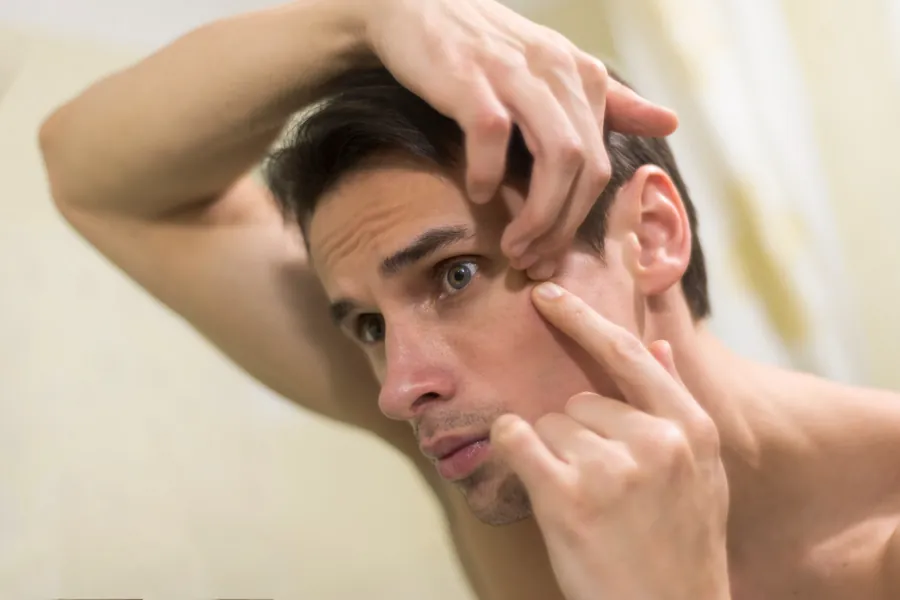
What happens if you squeeze an inflamed pimple?
The pressure can damage the inflamed hair follicle and the surrounding skin tissue. As a result, the pimple can become even redder, more swollen and more painful, and can take longer to heal.
What is more, picking with the fingers can cause further irritation. In other words, the pimple we “just wanted to get rid of quickly” may end up remaining visible for days longer.
Does squeezing pimples increase the risk of scarring?
Yes. Regularly squeezing and picking at pimples can increase the risk of scars and of the marks that remain after pimples.
The deeper and more inflamed a pimple is, the more important it is to leave it alone. And if deep, painful or scarring pimples appear frequently, it is worth seeking the help of a dermatologist instead of squeezing.
A simple rule
If a pimple would have to be squeezed by force, it is better not to squeeze it.
What is true and what is a myth about acne?
A great deal of advice and many myths circulate about acne – especially on social media. Let us briefly look at the most common ones.
MythAcne develops because the skin is not clean.
FactAcne is not the result of poor hygiene. In fact, cleansing the face too often or too harshly can irritate the skin and make matters worse.
MythOily skin does not need moisturising.
FactOily skin can be dehydrated too. A light moisturiser suitable for acne-prone skin can be particularly useful if the treatment dries or irritates the skin.
MythSunbathing gets rid of acne.
FactA tan can temporarily make pimples less visible, but it does not treat the cause of acne. What is more, UV radiation can intensify the pigment marks left behind after pimples.
MythToothpaste is good for pimples.
FactToothpaste is not an acne treatment, and it may contain ingredients that irritate or dry out the skin. For pimples, it is better to use active ingredients designed for this purpose.
MythMake-up always makes acne worse.
FactNot necessarily. You can wear make-up with acne-prone skin – it is worth choosing non-comedogenic products and removing make-up thoroughly in the evening.
MythAcne only occurs in teenagers.
FactAlthough it is very common in adolescence, acne can also develop or persist in adulthood.
MythEvery pimple is hormonal in origin.
FactHormones can play an important role in the development of acne, but not every pimple is “hormonal”. Acne develops as the combined result of several factors.
Frequently asked questions about acne (FAQ)
What is acne?
Acne (acne vulgaris) is a common, inflammatory skin disease that can involve blackheads and whiteheads, red or pus-filled pimples and, in more severe cases, deep, painful lumps.
What causes acne?
Several factors play a role in the development of acne, including excess sebum production, clogging of the hair follicles, the interactions between Cutibacterium acnes and the skin microbiome, and inflammation.
How can I get rid of acne quickly?
Acne generally cannot be cleared up in a few days. Even with appropriate treatment, it can take several weeks before the first visible improvement, which is why consistency and patience are important.
Is it OK to squeeze pimples?
It is not recommended. Squeezing can increase inflammation, prolong healing and raise the risk of marks and acne scars developing.
Which active ingredients can help against acne?
Retinoids, benzoyl peroxide, salicylic acid and azelaic acid, among others, are used in the treatment of acne. Which one is appropriate also depends on the type and severity of the acne.
How long does it take for acne to clear up?
There is no timeframe that applies to everyone. The first results of treatment often appear after a few weeks, while more significant improvement may take several months.
Can you grow out of acne?
For many people, yes, but not for everyone. Teenage acne can improve as hormonal changes subside, but acne can also persist into adulthood or even appear for the first time then.
When should I see a dermatologist about acne?
It is worth seeing a dermatologist if the acne is deep, painful or scarring, affects a larger area, does not improve over a prolonged period, or if it is unclear whether it really is acne.
Summary
Acne is not simply a few pimples, and it is not the result of inadequate washing. Several processes play a role in its development, which is why the right treatment is not the same for everyone either.
In milder cases, a well-chosen skincare routine and appropriate active ingredients can help a great deal, while for inflamed, painful, recurring or scarring acne it is worth seeing a dermatologist. The most important thing is patience: treating acne is usually a matter of weeks or months, not days.
And if you are not sure whether what you see on your skin really is acne, it is not worth experimenting at random with different products for months on end. A red, inflamed or pimple-like lesion is not always caused by acne: rosacea, folliculitis, perioral dermatitis or another skin problem can cause similar symptoms – and their treatment may differ from that of acne.
With AIP Clinic's online dermatology service, you can get help from a specialist from home. Send photographs of the skin problem and the necessary information, and a specialist will evaluate your case, help determine what may be behind the symptoms, and what further treatment may be warranted.
This article is for information purposes only and does not replace examination, diagnosis or treatment by a medical specialist. If you have a skin complaint, please consult a dermatologist.
Sources
- Tan JKL, Bhate K. A global perspective on the epidemiology of acne. Br J Dermatol. 2015;172(Suppl 1):3–12. (global prevalence: 9.4%, eighth most common disease) – pubmed.ncbi.nlm.nih.gov
- Acne vulgaris. StatPearls, NCBI Bookshelf – ncbi.nlm.nih.gov
- Reynolds RV, et al. Guidelines of care for the management of acne vulgaris. J Am Acad Dermatol. 2024. (combining topical treatments, oral antibiotics, isotretinoin, 6–8 weeks) – aad.org
- Acne vulgaris: pathogenesis and treatment. Journal of Dermatological Science / ScienceDirect – sciencedirect.com
- The skin microbiome and acne. PMC – pmc.ncbi.nlm.nih.gov
- Acne vulgaris: epidemiology and quality of life. PMC – pmc.ncbi.nlm.nih.gov